Monday, May 14, 2012

Bad Anthro Theatre


I haven’t really reviewed a movie since my days in graduate school at the Arizona Daily Wildcat, but I watched a really bizarre and horrid one the other night that kind of begs to be belittled.
               It’s called “Alleged” – and it’s unclear just what the title actually refers to, because it’s about the famous “Monkey Trial” in which John T. Scopes was charged with, and convicted of, the crime of teaching evolution in Dayton,Tennessee in 1925.  Nobody ever said he was innocent during the trial; his defense was basically about the badness of the law.
               This weird movie purports to be the “real” story of the Scopes Trial, unlike the classic play and movie “Inherit the Wind,” which contains numerous errors.  Well let’s start right there.  “Inherit the Wind” contains no errors at all, because it is a work of fiction, a “roman-a-clef”.  There is no John Scopes, there is Bertram Cates; there is no Clarence Darrow, only Henry Drummond, no William Jennings Brian, only Matthew Harrison Brady; and no H. L. Mencken, only E. K. Hornbeck.  Further, it is about the McCarthy era, not the Roaring Twenties.  Sure it takes place in the Roaring Twenties, but the play was about the political suppression of ideas, which was the issue in the 1950s, when it opened.
               “Alleged,” however, self-consciously asserts its verisimilitude, even going so far as to use the real names of the famous principals, as it butchers the very reality it claims to imitate.  The movie takes place in a preternaturally clean rural Southern town, free of class prejudice and the Ku Klux Klan, much less the fire-and-brimstone caterwauling  of the age. 
               The movie then integrates a eugenics sub-plot to tie evolution to eugenics.  Now this is something I am a bit sympathetic to, since I’ve written about it over the last few years.  There’s only two problems with this plot contrivance.  First, eugenics didn’t actually come up at the trial.  And second, the people the movie demonizes – Darrow and Mencken – are the ones who actually wrote eloquently against eugenics (shortly after the trial ended).  In Mencken’s literary magazine, The American Mercury, Darrow called the eugenicists “irresponsible fanatics”.  In the Baltimore Sun, Mencken  called eugenics “mainly blather”. 
               William Jennings Bryan was very much the pacifist and isolationist, and was ahead of his day in his views on equality and his views again social Darwinism.  But he didn’t write specifically against eugenics.  Darrow and Mencken did. 

               In fact, Darrow published his critique of eugenics in H. L. Mencken’s literary magazine, The American Mercury.   When the very first biologist to make a public critique of eugenics comes forward, it is H. L. Mencken’s friend, the Johns Hopkins geneticist Raymond Pearl.  And he publishes as well in The American Mercury, and it is so newsworthy that it gets picked up by the wire services and makes headlines all across America.  Story goes that it even cost Pearl an offer of a professorship at Harvard.   The point is that, far from being the eugenicist that the film depicts, it is hard not to see Mencken’s hand all over the mobilization of American opinion against eugenics.
               What little there is of the famous cross-examination of Bryan by Darrow – the climax of “Inherit the Wind” – is actually condensed into a single minute of this ridiculous movie.  This Bryan (played by former Senator Fred Thompson) is serene, thoughtful, and implacable for his minute of cross-examination.  The event actually took place on July 20, 1925, on a Monday after most of the journalists (including Mencken) had left town.  Serene, thoughtful, implacable.  This movie’s cross-examination gives us no glimpse of whatever inspired The New York Times to include in their next day’s Page One headline, “Angered, He Shouts That He Is Fighting for God against America’s Greatest Atheist”.
               What’s even weirder is that this film plays around with the actual court testimony just as egregiously as “Inherit the Wind” did, except that his film claims not to be doing so, which means that it is more of a lie than “Inherit the Wind” could possibly be.   For example, when William Jennings Bryan  volunteers that he believes that the “days” of creation may have been indefinitely long periods of time (he wasn’t tricked into it, as “Inherit the Wind” implies), this movie has Darrow respond “You do not!”
               The truth is much more interesting.  Darrow was surprised to learn that Bryan accepted the age of the earth, but would certainly not accuse Bryan of perjuring himself by lying about his beliefs under oath.  But District Attorney Tom Stewart immediately realized Bryan’s answer was a big problem, and interrupted.

STEWART: I want to interpose another objection. What is the purpose of this examination?
               But he was too late.  Bryan was already orating.

BRYAN: The purpose is to cast ridicule on everybody who believes in the Bible, and I am perfectly willing that the world shall know that these gentlemen have no other purpose than ridiculing every Christian who believes in the Bible.
               But Darrow hardly ever let an adversary have the last word.

DARROW: We have the purpose of preventing bigots and ignoramuses from controlling the education of the United States, and you know it, and that is all.
               So Bryan continued speechifying.

BRYAN: I am simply trying to protect the Word of God against the greatest atheist or agnostic in the United States. I want the papers to know I am not afraid to get on the stand in front of him and let him do his worst. I want the world to know that agnosticism is trying to force agnosticism on our colleges and on our schools, and the people of Tennessee will not permit that to be done.
               Cue the applause.  The day ended about a half-hour-later, and not at all serenely, as this movie suggests.  In fact, “Inherit the Wind” captures the chaos a lot better.  Here is how the day ended, not at all suggested in Senator Fred Thompson’s portrayal.

BRYAN: Your Honor, I think I can shorten this testimony. The only purpose Mr. Darrow has is to slur at the Bible, but I will answer his questions. I will answer it all at once, and I have no objection in the world. I want the world to know that this man, who does not believe in a God, is trying to use a court in Tennessee to slur at it, and, while it require time, I am willing to take it.
DARROW: I object to your statement. I am examining you on your fool ideas that no intelligent Christian on earth believes!
JUDGE RAULSTON: Court is adjourned until nine o'clock tomorrow morning.
               I thought it was pretty weird also when Darrow reviews human evolution privately with his scientists and reduces the fossil evidence to Java Man, Nebraska Man, and “Boxhole Man”.  I think the screenwriters probably meant “Boxgrove”.  You’d think the scientists would have been even passingly familiar with “Neanderthal Man” and “Piltdown Man” (both of which were indeed known at the time, although the latter turned out to be unreal, like the Paluxy River footprints that prove humans lived with dinosaurs). 
               Nebraska Man is interesting, because it does represent an egregious example of scientific overreach.  By 1927 it was understood to be a peccary.   Isolated, worn teeth are sometimes not as clearly diagnostic as we might like, but it certainly wasn’t something solid enough to bludgeon the creationists with, and often quite snarkily.  Historian Constance Areson Clark discusses this in her very interesting recent book, “God or Gorilla”.
              The plot of “Alleged” is actually a clumsy, vapid romance between a budding newsman and his budding girlfriend, set against the backdrop of the trial.  The newsman has no family except a dead father, and the girlfriend has a black half-sister, which isn’t at all scandalous in clean, rural 1925 Tennessee.
               The real problem is the idea that a counter-lie must be put out there to offset a prior lie, in this case,  the filmmakers’ perception of “Inherit the Wind”.  This is, I think, related to the stupid creationist idea that there are exactly two sides to any story: the scientific and the Biblical.  And since it is a zero-sum game, anything bad for science must ipso facto be good for the Bible.  So making Mencken look bad must make Jesus look good. 
               The biggest lie of all, however, is actually in the credits.  After placing the story in the backdrop of “actual” events and “real” personages, in order to claim a degree of verisimilitude that they don’t actually deserve, the producers actually show the standard disclaimer.


Paradoxically, that is probably the truest thing about the movie.

Saturday, March 17, 2012

Gorilla my dreams, I adore you

What to do about geneticists?  On one hand, they are so smart that we should accept whatever they say, no matter how absurd, inaccurate, or even racist it may be.  (See Nicholas Wade’s Before the Dawn).[1]   On the other hand, they’re ignorant and arrogant assholes and they should be thrown in jail (See Trofim Lysenko).[2]  There has got to be a middle ground.

The gorilla genome is now out, and when combined with human, chimpanzee, and orangutan, it allows us to do a phylogenetic comparison.[3]  We have known since the 1980s that human-chimp-gorilla genetically is a very close call, with DNA tending to place humans and chimps a little closer, but only with a lot of discordance or statistical noise.  (That is in fact exactly what the ill-fated DNA hybridization showed, although it was infamously misrepresented.)  When the mtDNA data first came out [4] they linked human to chimp pairwise, but only if you ignored the fact that over half of the phylogenetically informative DNA sites did not in fact show it to be human-chimp.   Those data showed it to be chimp-gorilla and human-gorilla.  The only way to extract human-chimp from those data was to treat the question like a Republican primary, where whoever gets the plurality of the votes wins the state.  So human-chimp was Mitt Romney, winning the nomination, but with barely 45% of the phylogenetically informative sites.

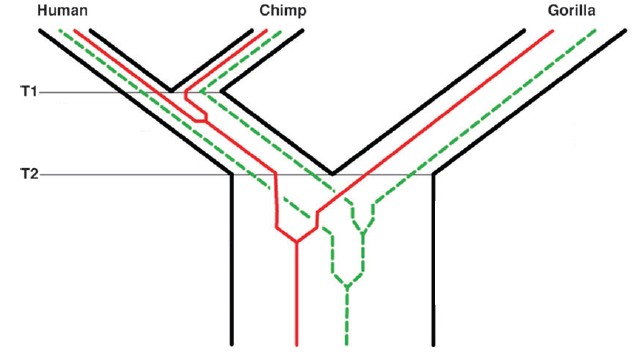
It then becomes a trivial task to explain away the discordant data, that is to say, the 55% of your data that you have decided is giving you the “wrong” answers.   You say it is “incomplete lineage sorting” or the result of ancestral polymorphisms, which have segregated into descendant taxa in a pattern different from the sequence of speciation.  Geneticists illustrate this with images that always seem to remind me of maps of the London Underground, with chimpanzees being Bakerloo and humans Victoria Station.


But I digress. It might also be parallel mutation or even backcrossing.  The problem, though, is that you have a lot of  homoplasy, and one of the assumptions of cladistic/phylogenetic analysis is that homoplasy (i.e., observed as discordance) is very, very low compared to synapomorphy (i.e., the shared derived characters that you think are tracking the actual branching history of the species).

This is the equivalent of simply choosing the most parsimonious solution to the phylogenetic problem.  Most of the data that give a pairwise resolution give this pairwise resolution, therefore it must be the right one.  But there is an inherent contradiction in this logic.  You are choosing the most parsimonious solution in a system that is not obviously very parsimonious.  In other words, if you are willing to accept the possibility that 55% of your phylogenetically informative sites are homoplasies (that is to say, are giving you the “wrong” answer), then how can you reject the idea that 70% of your sites might be giving you the “wrong” answer?  I talked about this many years ago in the American Journal of Physical Anthropology.[5] 

The model that fits the data best is not a model of two successive bifurcations, but what we called at the time a “trichotomy” and now would call “reticulate” or even “rhizotic” evolution.[6] [7]

The geneticists working on this problem have been hampered by the cladistic necessity of regarding speciation as events, rather than as processes – when their ape data are showing speciation as processes, not as events.  The new paper on the gorilla genome says that 30% of their phylogenetically informative sites are discordant.  This is how the new paper imagines the genomic relationships of humans, chimps, and gorillas – as indicating two temporally isolated speciation “events” and whatever the hell is going on in the middle there.


The creationists jumped all over this inconsistency, and it really is just the result of sloppy thinking by the scientists.


In trying to plug the genomic data into sequential speciation events, we are committing the square-peg-round-hole fallacy. There are historical and ideological reasons for depicting it as two successive, temporally distinct “events,” but that certainly misrepresents the evidence, and most likely misrepresents the biological history.  One of the most bizarre illustrations was in a recent introductory textbook, which showed this to students:


It’s trying to say that there were two speciation events, 7 mya and 6 mya, but has located the 7 mya event incorrectly.  If you look at the scale, you’ll see that it’s actually drawn at 8 million, to put a separation between them that shouldn’t be there.  The same text draws it this way a bit later. with very little (vertical) time separating the two “events” at 7-8 mya and 5-7 mya, but a lot of (horizontal) space.  That ought to learn ‘em!

Obviously, that’s not the text I use. 

The new paper on the gorilla genome, I might add, sets the “speciation events” at 6.0 and 3.7 mya.  The 3.7 mya date for the divergence of human and chimpanzee is simply, to the extent that anything can be falsified in the fossil record, false - although it is oddly congruent with some of Vince Sarich and Allan Wilson’s early writings on the subject in the 1960s.[8]  The (myriad) authors of the new paper go on to argue that they can juggle some of the parameters in their computer program to make the dates come out to about 6 and 10 million years ago – as if that is supposed to give us confidence!

For the Alternative Introduction, I drew this figure to illustrate the problem.


Rather than prurient talk about cross-species buggery on the part of early hominids, how about speciation here as a temporal process, and populations through time as anastemosing capillary systems (Earnest Hooton’s metaphor, expressing the same point as rhizomatic and reticulate evolution).  It is also noteworthy that we tend to model and depict the gene pools of all three species as equivalent, when we’ve known for years that chimps and gorillas, even as relict populations, have gene pools that are considerably more extensive than that of our own species.  That is to say, Homo sapiens is relatively depauperate in genetic diversity.  The only study to try and incorporate that information into a phylogenetic analysis, many years ago, found that it completely obscured the phylogenetic “signal” and that it was therefore a fool’s errand to try and extract two successive bifurcations from a genomic analysis of human, chimpanzee, and gorilla.[9] 

Interestingly, the new paper actually did look at diversity in gorilla genomes, but didn’t incorporate that into their phylogenetic analysis.  Bottom line:  Human evolution is probably more interesting than the geneticists realize.


[1] Wade N. 2006. Before the Dawn: Recovering the Lost History of Our Ancestors. New York: Penguin.

[2] Medvedev Z, and Lerner I. 1969. The Rise and Fall of TD Lysenko. New York: Columbia University Press.

[3] Scally A, Dutheil JY, Hillier LW, Jordan GE, Goodhead I, Herrero J, Hobolth A, Lappalainen T, Mailund T, Marques-Bonet T et al. . 2012. Insights into hominid evolution from the gorilla genome sequence. Nature 483(7388):169-175.

[4] Horai S, Satta Y, Hayasaka K, Kondo R, Inoue T, Ishida T, Hayashi S, and Takahata N. 1992. Man's place in hominoidea revealed by mitochondrial DNA genealogy. Journal of Molecular Evolution 35(1):32-43.

[5] Marks J. 1994. Blood will tell (won't it?)? A century of molecular discourse in anthropological systematics. American Journal of Physical Anthropology 94:59-79.

[6] Marks J. 1995. Learning to live with a trichotomy. American Journal of Physical Anthropology 98:211-213.

[7] Arnold M. 2009. Reticulate Evolution and Humans: Origins and Ecology. New York: Oxford University Press.

[8] Sarich VM. 1968. The origin of the hominids: An immunological approach. In: Washburn SL, and Jay PC, editors. Perspectives on Human Evolution I. New York: Holt, Rinehart, and Winston. p 94-121.

[9] Ruano G, Rogers, Jeffrey A., Ferguson-Smith, Anne C., Kidd, Kenneth K. 1992. DNA sequence polymorphism within hominoid species exceeds the number of phylogenetically informative characters for a HOX2 locus Molecular Biology and Evolution 9(4):575-586.

Thursday, February 2, 2012

Ten points for evolutionary psychology (but not a touchdown and a field goal)

1.  There is no Environment of Evolutionary Adaptedness.  “Pleistocene Africa” covers a lot of time and turf.[i]

2.  The Descent of Man is Darwin’s worst book, full of sexist Victorian claptrap. Even William Jennings Bryan knew that.[ii] 

3.  What 1000 male college students in Texas think about women cannot be extrapolated to the minds of the entire human species.  Nor can they be extrapolated to the minds of australopithecines, in spite of the obvious joke.

4.  Homology is a Darwinian relationship, the result of common descent; analogy is a literary device, the application of metaphor.  Humans have slavery; ants have “slavery”.   Humans rape; ducks "rape”.  Humans wage war; chimpanzees “wage war”.[iii]   

5.  Life evolves; culture “evolves”.[iv]  Even Herbert Spencer knew that.

6.  Homologous does not mean “the same as”.   A sparrow’s wing is homologous to your arm, but it can flap it and fly away and you can’t.  A chimp’s foot is adapted for grasping;  a human’s foot is adapted for weight-bearing.  Their brains are adapted to different functions as well.

7.  Whether or not chimpanzees are cultural, they are doing things quite differently than humans are, so you still have to come up with a different descriptor for human behavior: like “euculture” or “accumulated culture”.[v]  It’s the same distinction, and we’ve already made it. 

8.  A non-cultural chimpanzee is a chimpanzee; a non-cultural human is a corpse.

9.  There is no human nature independent of human culture.[vi]

10.  Hunter-gatherers are no more human than the rest of us, your ancestors did not live in the Kalahari desert, and the Yanomamo aren’t hunter-gatherers.


And one more for good measure:  Reading a book by Steven Pinker does not make you an expert on human evolution.


[i] Irons, W.  1998.  "Adaptively Relevant Environments Versus the Environment of Evolutionary Adaptedness."  In Evolutionary Anthropology.  6:194-204.

[ii] “Darwin explains that man’s mind became superior to woman’s because, among our brute ancestors, the males fought for the females and thus strengthened their minds.  If he had lived until now, he would not have felt it necessary to make so ridiculous an explanation, because woman’s mind is not now believed to be inferior to man’s”  (Bryan W. J. 1922. God and evolution. The New York Times, 26 February.).

[iii] Simon, M. A.  1978.  "Sociobiology: the Aesop's fables of science."  In The Sciences.  18:18-21.

[iv] Fracchia, J. and Lewontin, R. C.  1999.  "Does culture evolve?"  In History and Theory.  38:52-78.

[v] Wilson, E. O. and Lumsden, C. J.  1981.  Genes, mind and culture: the coevolutionary process.  Harvard University Press.  Mesoudi, A.  2011.  Cultural Evolution: How Darwinian Theory Can Explain Human Culture and Synthesize the Social Sciences.  University of Chicago Press.

[vi] See Clifford Geertz’s 1966 essay “The Impact of the Concept of Culture on the Concept of Man” reprinted in The Interpretation of Cultures (1973).  More recently, Keller, E. F.  2010.  The Mirage of a Space Between Nature and Nurture.  Duke University Press.  And nicely reviewed by Jason Antrosio 
www.livinganthropologically.com/anthropology/human-nature/

Saturday, December 31, 2011

Simpson story #3

One day in 1983, while I was over at the Simpsons’ doing the typing, I mentioned that the local PBS station in Tucson was about to start re-running the Richard Leakey series, “The Making of Mankind”. Anne Roe Simpson thought it would be lovely to watch over lunch, and George agreed, and so we toodled off from the library into the house and turned on the TV.

Anne made George his lunch (two martinis, every day for half a century) and sat down to knit some booties for their new great-grandchild.  The show begins; it’s the introduction to the series.  Richard Leakey comes on.  Anne mentions how they happened to be visiting Rusinga Island when his mother Mary found that Proconsul fossil.  Remember, G?  (She called him ”G”.  Nobody else did.)  GGS starts sucking down his lunch and zoning out.

Richard Leakey comes back on, announcing to the audience that there are some wonderful new ideas in evolutionary theory, and we’re going to hear about them from the amazing and wonderful Stephen Jay Gould.  Gould comes on and says, “Stasis... blah blah blah ... change ... blah blah blah ... punctuated equilibria”.  Simpson, who had only a minute earlier been fading fast, suddenly straightens up, as if detecting the subtle presence of another adult male Hamadryas baboon nearby.  From behind the Coke-bottle eyeglasses, his eyelids pop open, like Mister Magoo’s.

“The great man is about to speak,” said the graduate student in my head, “So listen carefully.”   Gould’s star had risen to the apex of evolutionary biology – I had been an avid reader of his Natural History columns since starting graduate school in the late 1970s.  And now I was going to hear what George Gaylord Simpson had to say about his work.

Simpson leaned forward.  The future faux historian in me froze the moment.  And Simpson said, “Boo!  Boo!  Boo!”   Even Anne joined in:  “Hiss!  Boo!”

And that is what I remember, for all time:  George Gaylord Simpson booing at Stephen Jay Gould on the fucking television set.

*********

          Simpson felt as though Gould had been making his own reputation in part by putting him down.  In particular, he didn’t like Gould’s argument that Simpson “had it” in Tempo and Mode in Evolution (1944) but “lost it” in The Major Features of Evolution (1953).  He felt, to some extent rightly, besieged by the punctuated equilibriists, the cladists, and the vicariance biogeographers – all of whom were bouncing their new ideas off of Simpson’s – without being able to see that as a testament to the scope of his impact upon the field.  Once I suggested that one could make an analogy to Darwin’s first (1859) and last (1872) editions of The Origin of Species.  The first is the one that made a mark on the modern world, the one that caused the sensation by presenting a bold and convincing naturalistic explanation for adaptation and the taxonomic hierarchy, which had previously not had one.  The last edition is flabbier, because it incorporates rebuttals and side arguments that don’t really add much, over a century later.  So maybe the first one is the more important one to read, all things considered, and maybe the same holds for Gould’s point about the importance of Tempo and Mode in Evolution.

Frankly, I have no idea where I got the balls to say such a thing to Dr. Simpson.  I  can only guess that it must have been after lunch, so he was a bit mellow.  He just growled, “The sixth was the one that Darwin intended for posterity.”

Years later, though – Darwin’s own Victorian inbred sexist intentions be damned! - I recommend  the first to students.  That was the important one.

Gould's essay, though, pissed off Simpson so much that when Gould subsequently published a Natural History piece on how his three idols while growing up were his father, Joe DiMaggio, and George Gaylord Simpson, GGS wrote him a nasty letter that ended something like, “and I don’t want to be your idol any more, either!”  True to his word, when PBS did a profile of Gould a few years later, Gould looked straight into the camera and told the audience how his three idols while growing up had been his father, Joe DiMaggio, and ... Charles Darwin.

Gould SJ. 1981. G. G. Simpson, paleontology, and the modern synthesis. In: Mayr E, and Provine, W., editor. The Evolutionary Synthesis. Cambridge: Harvard University Press. p 153-172.

***********

Here’s something new, a book on applied evolution, based on a wonderful Darwin Bicentennial Symposium in Melbourne, back in ’09 (as Victoria was on fire, I recall). 


I’m essay #16, in between Douglas Futuyma and Michael Ruse, here to remind you what a lousy idea it was to try to apply evolution to human society a century ago.  Anthropologists are such killjoys, aren’t we?  

Friday, November 25, 2011

So, est-ce la science?

The American Anthropological Association’s one hundred and tenth annual meeting, held in Montreal, is over.  Over six thousand people registered, more than ever before, but certainly fewer than next year, barring another San Francisco chambermaid strike (which, you may recall, made us international laughingstocks just a few years ago).

               Had a pretty good time.  Saw a lot of people I like, and didn’t see too many I can’t stand.  (Those people tend to avoid the AAA, anyway.)  Overall, it was kind of cold, kind of inconvenient, and kind of expensive.

               So, Is This Shit Science?  Actually the session was called, Science in Anthropology: An Open Discussion.  (I know, I left out the “merde” in the title of this post, but I don’t know where to put it.)  Ad-libbed a line about how Whether or not this is science, I needed a fucking GPS to find this room.  Got a titter.  I think the only substantive thing I had to say was that there is no anti-science conspiracy in anthropology, and only a paranoiac would keep saying it.  Now the paranoiacs are out to get me. 

               Neither the organizer (Peter Peregrine) nor the chair (Virginia Dominguez) really had much to say.  I held in reserve the fact that the Association was going to present its “Anthropology in Media” award the following night to someone who runs a pseudo-scientific internet dating site based on an updating of the Hippocratic humors – in which you are governed by testosterone, estrogen, dopamine, or serotonin – as if that is something that brings honor to the practice of anthropology.  But it never came up.  (The site is called chemistry.com, and is not about to be honored by the American Chemical Society anytime soon. )

               Russ Bernard had some interesting demographic facts, but didn’t convince me that the primary issues are demographic.  (I’m still mad at having been told back in the 1980s that there were all these anthropologists about to drop dead, and there would be all these jobs available...)  From the floor, Karen Strier seemed to agree that the problem was ecological/demographic (people fighting over resources), rather than ontological (the complexity of rigorous thought in a subject that spans biological and symbolic processes).  I still like to cite an old paper by Ralph Linton, who observed in 1938 (in one of those great old review articles in Science that you just don’t see any more):

This current tendency to bring physical anthropology into closer liaison with a whole series of natural sciences may widen still further the gap between it and cultural anthropology. The connection is already so tenuous that a complete break between the two seems well within the bounds of possibility. The phenomena with which the two disciplines deal are of different orders and the question is whether there is any real link between these orders.

               I saw eye-to-eye with Dan Segal on most of the issues, except one – the “Evolution is just a theory” warning-sticker-on-the-textbook issue.  Dan seemed to say that it’s true, and actually is a teaching moment for the philosophy/anthropology of science.  Both clauses are right, but I don’t think you can so easily dismiss the fact that it really is about fundamentalist Christians trying to undermine science education in the United States.  I think it would be a great idea for scientists to actually learn something about science before trying to teach about it (rather than how to do science, which they are good at), but allying with the creationists (or even the allowing the perception thereof) is not a winning formula.  There’s a too-clever-for-his-own-good sociologist of science named Steve Fuller, and a philosopher named Jerry Fodor, who have gone down that road, to the extent that nobody listens to them, in spite of the fact the they do indeed have something interesting to say.  (In fact, a really good historian named David Livingstone recently sent me a manuscript on that very subject.)

               On the other hand, the teaching of anthropology is also under unprecedented threat.  Not just in Florida, either (where the Republican governor, apparently frustrated by his daughter’s enlightened choice of a major, called anthropology out as singularly undesirable.  I can understand why – Edward Tylor had defined it as “a reformer’s science” way back in 1871.)   Actually, one of the creepiest bits of information I picked up (at the business meeting) is that there are no longer any departments of anthropology in any of the historically black colleges in the US.  Frankly, I haven’t seen the evolutionary biologists flocking to our defense.

               Maybe something else interesting was said.  It made The Chronicle of Higher Education’s blog the next day.  Julienne Rutherford keeps threatening to post a video of it. 

---------------------------------------------


Fodor JA, Piattelli-Palmarini M. 2010. What Darwin Got Wrong. New York: Farrar Straus & Giroux.

Fuller S. 2008. Dissent Over Descent: Intelligent Design's Challenge to Darwinism. New York: Icon Books.

Linton R. 1938. The present status of anthropology. Science 87: 241-48.

Tylor EB. 1871. Primitive Culture. London: John Murray.

Wednesday, October 26, 2011

Tell us about Washington, son - Is it run by a bunch of crooks?

            It’s funny how political humor from 60 years ago could still stand up today.  Li’l Abner was a fairly subversive political satire when it started running in the 1930s, the “Doonesbury” of its day.  Like Lucy and Desi’s baby a few years later, the marriage of Abner Yokum and Daisy Mae Scragg was a huge media event in 1952.  In 1956 it was turned into a Broadway musical, with a fine score by Johnny Mercer and Gene DePaul, and a villainous plutocrat called General Bullmoose (“He makes the rules and he intends to keep it that-a way / What’s good for General Bullmoose is good for the USA”).

            The most famous song is about Jubilation T. Cornpone (unshaven and shorn-pone!), but the most amazing thing is the Foucaultian eugenics song, sung by the government’s scientists:

Fellow scientists!  What delicious conformity!  Imagine – all reactions completely, utterly, precisely alike!  Think of the unbounded horizons of science!  When we can make all mankind look, act, think, feel, hope, desire, dream, buy and sell, inhale and exhale, exactly alike!

Oh, happy day, when miracles take place
And scientists control the human race,
When we assume authority of human chromosomes,
And assembly-line women, conveyor-belt men, settle down in push-button homes.

Oh, happy day, when all the cells conform
And the exceptional becomes the norm,
When from a test-tube we produce gargantuas or gnomes,
And assembly-line babies, conveyor-belt storks, only come to push-button homes.

So much of this, so much of that for the ears and eyes,
So much of that, so much of this for the toes and thighs.
Pour in a pot, stir up the lot, that's the basic plan,
What have we got? I'll tell you what: We've got man-made man!

Oh, happy day, when we can choose their looks
From formulae in scientific books
And add their personalities from psychiatric tomes
And assembly-line women, conveyor-belt men, settle down in push-button homes.


But what is inspiring this blog entry is the song describing the government after Li’l Abner visits DC for the first time.  Here is a clip from the 1959 film version of the musical, which retained the male Broadway principals, but not the females (Leslie Parrish for Edie Adams as Daisy Mae, and Stella Stevens for Tina Louise as Appassionata von Climax, but notably retaining the immortal Julie Newmar as Stupefyin’ Jones).  The indented material was deleted from the movie, but it’s all still amazingly resonant.


Them city folks and we’uns
Are purdy much alike
Though they ain't used to living in the sticks.
We don't like stone or ce-ment
But we is in agree-ment
When we gets down to talking politics

The country's in the very best of hands, the best of hands, the best of hands

The treasury says the national debt is climbing to the sky,
And government expenditures have never been so high,
It makes a feller get a gleam of pride within his eye
To see how our economy expands.
The country's in the very best of hands

The country's in the very best of hands, the best of hands, the best of hands.

[You oughtta hear the senate when they’re drawing up a bill
Whereases and to-wits are crowded in each codicil
Such legal terminology would give your heart a thrill
There's phrases there that no one understands
The country's in the very best of hands

The building boom, they say, is getting bigger every day
And when I asked a feller “How could everybody pay?”
He come up with an answer that made everything okay:
“Supplies are getting greater than demands.”
The country's in the very best of hands

Don't you believe them congressmen and senators are dumb
When they run into problems that is tough to overcome
They just declares a thing they calls a “moratorium”:
The upper and the lower house disbands.
The country's in the very best of hands.]

The farm bill should be eight-nine percent of parity.
Another fellow recommends It should be ninety-three.
But eighty, ninety-five percent, who cares about degree,
It's parity that no one understands!
The country's in the very best of hands

Us voters is connected to the nominee,
The nominee's connected to the treasury,
When he ain't connected to the treasury,
He sets around on his thigh bone.

They sets around in this place they got,
This big congressional parking lot,
Just sets around on their you-know-what,
Up there, they calls it their thigh bone.

Them bones, them bones gonna rise again
Gonna exercise the franchise again
Gonna tax us up to our eyes again
When they gets ‘em off’n their thigh bone

The country's in the very best of hands, the best of hands, the best of hands

Them GOP's and democrats each hates the other one.
They's always criticizing how the country should be run.
But neither tells the public what the other’s gone and done.
As long as no one knows where no one stands,
The country's in the very best of hands

[They sits around in this place they’re at,
Where folks in Congress has always sat
Just sits around on their excess fat,
Up there they calls it their thigh bone

They sits around till they starts to snore
Jumps up and hollers “I has the floor!”
Then sits right down where they sat before.
Up there they calls it their thigh bone.

Them bones, them bones gonna rise again
So dignified and so wise again
While the budget doubles in size again
When it gets them off of their thigh bone

The country's in the very best of hands the best of hands, the best of hands]

The money that they taxes us, that's known as revenues.
They compounds the collaterals,  subtracts the residues.
Don't worry about the principal and interest that accrues,
They're shipping all that stuff to foreign lands
The country's in the very best of hands


So here’s the genetics question:  Which of the actors in that clip do I share 12.5% of my DNA with, by descent,  including my Y chromosome?  I’ll  give you a hint, it’s my father’s father’s brother.  No, it’s not Peter Palmer (Abner), and it’s not Stubby Kaye (Marryin’ Sam). 
            Watch carefully when Pappy Yokum says “Tell us about the government, all them crooks!” at 0:59.  See the resemblance? 
            All right, this is like Hamlet convincing Polonius to see camels and whales in the clouds.  I might as well be related to Julie Newmar.  But that’s Joe E. Marks.  He was in several things:  He played Smee in the Mary Martin – Cyril Ritchard  “Peter Pan” and he was the first person on camera in the Lesley Ann Warren  - Rodgers & Hammerstein “Cinderella”.  You can also hear him here, in the 1965 musical, “Flora, The Red Menace” which was Liza Minnelli’s first Broadway lead:


And I still have her autograph, from when we went backstage and met her.  I think it was just before 3M invented invisible tape.


Al Capp, the cartoonist who drew Li’l Abner, was quite a douchebag in real life, no matter what his politics.  Although his politics were progressive in first few decades of Li’l Abner, he swung to the right as the country moved to the left.  Here he chats with John and Yoko, and sounds almost like Eric Cartman.  At the time, he and John Lennon were about equally famous, and both were more famous than you-know-who.  


Oddly, although alkaptonuria was one of the first diseases shown to be inherited genetically, he didn’t have it.


Thursday, September 29, 2011

Everybody’s favorite Nazi vacuum-cleaner mogul

               Once upon a time there was an incredibly hot Danish model, named Inga Arvad.  How hot was she?  She was named Miss Denmark, 1928.   She parlayed that crown into a movie career, although that career only lasted for two movies: most notably, Flugten fra Millionerne, something like “Fleeing from the Masses”.   She marries the director, a charismatic Hungarian doctor/explorer/filmmaker named Pál Fejös, whom we will call Paul Fejos.
               Fejos has some wealthy friends, including the founder of Electrolux Vacuum Cleaners, a Swedish industrialist named Axel Wenner-Gren.   Axel has branched out from vacuum cleaners to munitions, and some of his biggest clients are the Germans.  Inga decides that she’d rather do journalism than acting and modeling, and through Axel, she manages to get the first exclusive interview with Hermann Göring, Hitler’s right-hand man, and with Adolf himself.  At the 1936 Olympics (the Jesse Owens games), she sits in Hitler’s box and is introduced by him as the epitome of Nordic beauty.
               Inga emigrates to America shortly thereafter, and settles in New York, where she enrolls in the journalism school at Columbia University in 1940.  Her classmates, however, quickly tire of hearing her complaints about the Jews, and they put the FBI onto her as a possible Nazi spy.  When the G-Men break into her apartment, they discover that she has an autographed picture of Hitler on her mantelpiece, and so they conclude that she is not a Nazi spy – because what kind of a Nazi spy would have an autographed picture of Hitler in their living room? – but they decide to keep her under surveillance as a sympathizer. 
               She is still under surveillance, and still married, when she moves to DC to start writing a gossip column for a local paper, The Washington Post-Herald, and starts schtupping the dashing second son of the wealthy former US ambassador to England.  The former ambassador is Joseph P. Kennedy.  The son is John F.
               Suffice it to say, J. Edgar Hoover lived for shit like this.  He gets a hold of Papa Joe, and mentions that his son, in the Navy, is frolicking with this Nazi sympathizer.  Papa Joe mulls it over, and finds only three things wrong with his son’s amorous activities.  One, she’s married.  Two, she’s a Nazi.  And three, she’s a Protestant. 
               So he leaks the relationship to the columnist Walter Winchell, who writes on January 12, 1942:  “One of ex-Ambassador’s Kennedy’s eligible sons is the target of a Washington gal columnist’s affections.  So much so she has consulted her barrister about divorcing her exploring groom.  Pa Kennedy no like.”  The tryst is outed, and abruptly terminated, and Kennedy has his son sent first to South Carolina, and thence to the Pacific theater. 
               Winchell’s column, however, raised an interesting question:  Where was her “exploring groom”, and why wasn’t he at home with his smoking hot Nordic beauty queen columnist wife?
               Answer: Machu Picchu, of all places, with his old buddy Axel Wenner-Gren.  It seems as though Axel Wenner-Gren has some money in US accounts, and the Fed doesn’t like his politics, and are threatening to take it away from him, unless he does something philanthropic with it.  So Axel wants to start a fund for his side interest, Nordic studies, and would like Fejos to run it.  They compromise that it will be named after Wenner-Gren’s anthropological interest, but will be administered by Fejos according to normative anthropological ideas and interests.  And Fejos cables his wife (soon to be ex-wife), “Well, here it is, your first break in the greatest institution of newspaper writing in the U.S.  You made Winchell’s column.”
               Paul Fejos kept the Viking Fund, later the Wenner-Gren Foundation for Anthropological Research, resolutely anthropologically mainstream.  He consulted with the great ones at Columbia – Ralph Linton, Sherry Washburn – for suggestions about what to fund, and helped subsidize the development of radiocarbon dating, and disseminating Washburn’s new physical anthropology, etc. – to his everlasting credit, and to that of his successors.
               Because it could easily have been otherwise.  Around the same time, a wealthy textile merchant named Wickliffe Draper was looking to start a philanthropy by which to support like-minded scientists. He called it The Pioneer Fund, and tapped the eugenicist Harry Laughlin to be its first president, in 1937.   Laughlin had been awarded an honorary doctorate from Nazi-controlled Heidelberg University the year before, in recognition of his pioneering work in the field of encouraging the modern state to sterilize its citizens involuntarily.  The Pioneer Fund, throughout its history, has chosen its beneficiaries quite differently from The Wenner-Gren Foundation.  A list of their grantees reads like a Who’s Who of Anachronistic Biological Determinism, resolutely faithful to the principal scientific and political interests of its benefactor, all those years ago.  Its current president is the psychologist J. Philippe Rushton.

Lombardo, P. A. (2002) '"The American Breed": Nazi Eugenics and the Origins of the Pioneer Fund', Albany Law Review, 65: 743-830.

Rushton, J. P. (2002) 'The Pioneer Fund and the scientific study of human differences', Albany Law Review, 66: 207-262.

Tucker, W. H. (2002) The Funding of Scientific Racism: Wickliffe Draper and the Pioneer Fund, Urbana, IL: University of Illinois Press.

************************
I should add, old Axel Wenner-Gren sure knew how to make a vacuum cleaner.  My mother bought an Electrolux in 1950, and it still works.